
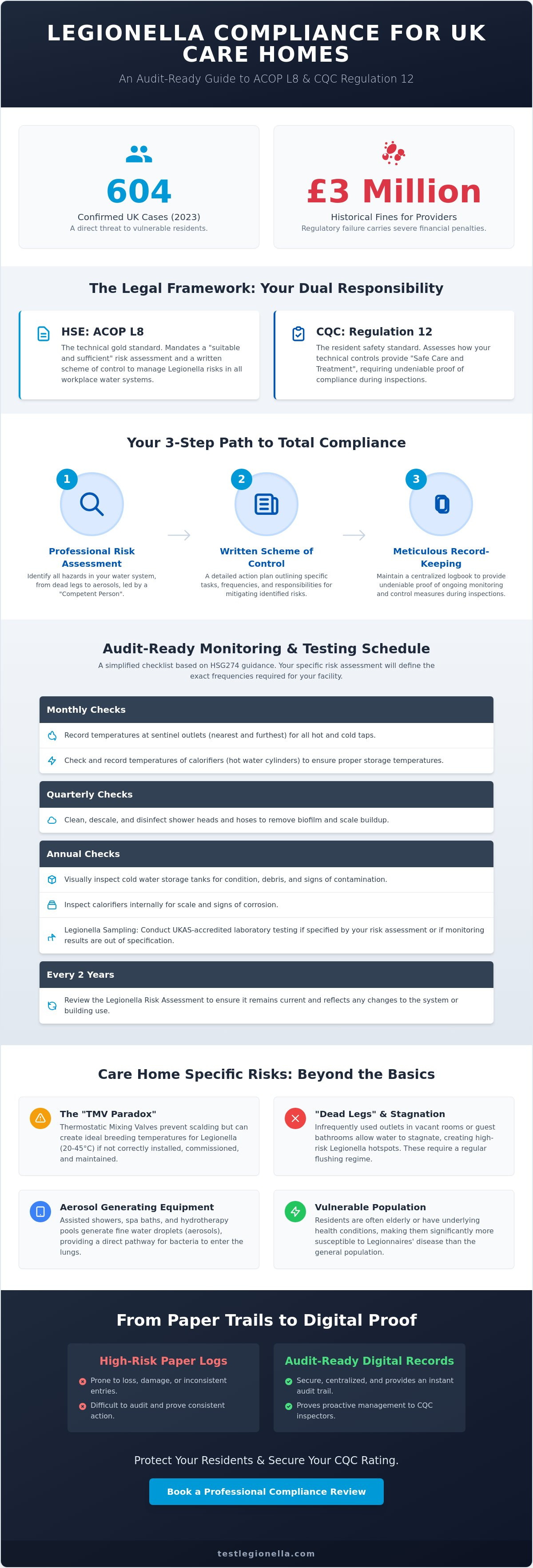
With 604 confirmed cases of Legionnaires' disease across the UK in 2023 and historical fines for care providers reaching as high as £3 million, water safety is far more than a simple maintenance task. It's a vital clinical safeguard for your most vulnerable residents. You're likely already feeling the pressure of an upcoming CQC inspection or feeling confused about the specific legionella testing requirements for care homes uk. Balancing routine temperature monitoring with the need for professional laboratory analysis can feel like a complex regulatory maze that carries heavy consequences for any oversight.
We understand that managing these high-stakes risks creates significant anxiety, especially when an "Inadequate" rating is on the line. This guide is designed to replace that stress with a sense of calm competence and total regulatory security. You'll learn exactly how to align your facility with the latest HSE and CQC water safety standards, including ACOP L8 and HSG274 requirements. We'll provide a clear, audit-ready testing schedule and explain how professional compliance testing protects your residents from water-borne pathogens while ensuring your home remains fully compliant through 2026.
Key Takeaways
- Align your facility with the latest HSE and CQC standards by understanding how ACOP L8 and Regulation 12 govern water safety in care settings.
- Identify the critical role of a "Competent Person" in conducting specialized risk assessments for the complex plumbing systems typical of care environments.
- Establish an audit-ready schedule that clarifies the specific legionella testing requirements for care homes uk, including monthly monitoring and annual inspections.
- Resolve the "TMV Paradox" by effectively managing thermostatic mixing valves to prevent both scalding and the growth of water-borne pathogens.
- Maintain a centralized, professional water safety logbook to provide the undeniable proof of compliance required during high-stakes CQC inspections.
The Legal Framework: ACOP L8 and CQC Regulation 12
Understanding the legal landscape is the first step toward achieving total compliance and peace of mind. In the UK, two distinct bodies govern your water safety: the Health and Safety Executive (HSE) and the Care Quality Commission (CQC). While their roles differ, their goal is identical: the prevention of infection. The HSE focuses on the technical mechanics of prevention through the Approved Code of Practice L8 (ACOP L8), while the CQC assesses how these technical controls translate into resident safety under Regulation 12. Meeting the legionella testing requirements for care homes uk isn't just a box-ticking exercise; it's a legal obligation that requires a clear chain of command and documented proof of action.
Every care home must have a designated "Duty Holder" and a "Responsible Person." The Duty Holder is typically the employer, CEO, or property owner who carries the ultimate legal weight for safety. They must appoint a Responsible Person, often a manager or maintenance lead, to oversee the day-to-day scheme of control. By 2026, the standard for compliance has shifted heavily toward robust digital record-keeping. Inspectors now expect an instant, transparent audit trail. Paper logs are increasingly viewed as high-risk due to the potential for loss, damage, or inconsistent entry. Digital systems provide the "live" data that proves you're proactive rather than reactive.
ACOP L8: The Technical Gold Standard
A "suitable and sufficient" risk assessment is the foundation of your safety strategy. This technical framework is designed to prevent outbreaks of Legionnaires' disease, a severe form of pneumonia that poses a lethal threat to elderly residents with weakened immune systems. Your assessment must identify every potential source of risk, from stagnant pipework in vacant rooms to temperature fluctuations in large storage tanks. Once risks are identified, you must implement a written scheme of control. This document details the precise actions your team takes to mitigate those risks. For a deeper dive into these technicalities, review our guide on the acop l8 framework for UK properties.
CQC Regulation 12: Safe Care and Treatment
CQC inspectors look for evidence of safety during every site visit, specifically under the "Safe" key question. Under Regulation 12, providers must demonstrate they're doing everything reasonably practicable to prevent infection. If your water safety logbook is incomplete or missing entries, it directly threatens your overall CQC rating. During new provider registrations, the CQC requires proof of a current, professionally conducted risk assessment. They'll scrutinize your records to ensure you're following a consistent schedule. Adhering to the legionella testing requirements for care homes uk ensures your facility remains audit-ready and your residents stay protected from preventable water-borne pathogens.
The Core Requirement: Professional Legionella Risk Assessment
A professional risk assessment isn't just a recommendation; it's the core of your safety strategy. Care homes are inherently high-risk environments. Their complex plumbing systems often feature extensive pipework, multiple storage tanks, and hundreds of outlets. This structural complexity, combined with the presence of vulnerable residents, means you must appoint a "Competent Person" to lead the evaluation. This specialist must possess healthcare-specific knowledge to satisfy the legionella testing requirements for care homes uk and ensure no hidden hazard is overlooked.
Your assessment must look beyond the obvious. It should pinpoint "dead legs"-redundant pipework where water can stagnate-and identify infrequently used outlets. In a care home, a vacant resident room or a guest bathroom can quickly become a hotspot for bacterial growth if not managed through regular flushing. Specialized equipment adds another layer of risk. Hydrotherapy baths and assisted showers are designed for comfort, but they also produce fine water aerosols. These aerosols provide a direct path for bacteria to enter a resident's lungs, making their maintenance a priority.
If you're unsure about the current state of your water system, you can book a professional compliance review to identify and mitigate these hidden risks.
When Should You Update Your Risk Assessment?
The HSE's ACOP L8 suggests a review cycle of at least every two years. However, don't treat this as a fixed date. Several triggers require an immediate re-assessment. These include significant modifications to your water system, changes in building occupancy, or evidence that your current control measures aren't effective. Integrating this review with a legionella risk assessment cost analysis helps you plan for these essential updates without budgetary surprises.
Identifying Vulnerable Resident Groups
Risk isn't just about the building; it's about the people inside. Elderly residents and those with underlying health conditions, such as chronic respiratory issues or weakened immune systems, are at a significantly higher risk. In healthcare settings, these groups are often three times more likely to contract an infection compared to the general population. Mapping this vulnerability to specific water outlets is a critical part of your safety plan. Understanding the biology of legionella in these environments allows you to target your testing where it matters most, ensuring residents remain protected.
Testing vs. Monitoring: Establishing Your Schedule
Establish a clear distinction between internal monitoring and professional laboratory testing. These two processes work together but serve different regulatory purposes. Monitoring involves your on-site team checking temperatures and flushing outlets. Testing requires a specialist to take water samples for UKAS-accredited analysis. To satisfy the legionella testing requirements for care homes uk, you must integrate both into a cohesive, documented safety schedule. Relying on one without the other leaves a gap in your audit trail and a potential risk to your residents.
Monthly checks should focus on sentinel outlets. These are the taps and valves nearest and furthest from your water heater or calorifier. You also need to inspect cold water storage tanks and hot water cylinders annually to check for sediment, debris, or signs of contamination. Quarterly showerhead descaling is another critical task. Limescale provides a nutrient source for bacteria, and showerheads create the fine aerosols that residents might inhale. If your maintenance team isn't currently tracking these tasks in a central logbook, your compliance is at risk.
The Temperature Regime: 60/50/20 Rule
Temperature control is your primary defense against bacterial growth. The HSE Approved Code of Practice (ACOP L8) provides a clear thermal framework for this. Hot water must be stored at a minimum of 60°C to kill bacteria within the tank. By the time it reaches the tap, it should still be at least 50°C after running for one minute. Conversely, cold water must stay below 20°C after running for two minutes. If your cold water warms up or your hot water cools down into the "danger zone" between 20°C and 45°C, you've created an ideal breeding ground for pathogens.
Professional Water Sampling and Laboratory Analysis
While temperature monitoring is a daily necessity, professional sampling provides the ultimate proof of safety. Most care homes require regular sampling because they house high-risk individuals in complex buildings. You'll also need lab testing if your temperature regime fails or if you've made significant changes to the plumbing. Lab results are measured in colony forming units per litre (cfu/l). If a report shows levels above 100 cfu/l, you must take immediate remedial action. This scientific validation is exactly what CQC inspectors look for to confirm your legionella testing requirements for care homes uk are being met with professional rigor.
Addressing Care Home Specific Risks: Aerosols and Thermostatic Valves
Care homes present a unique clinical challenge that standard commercial buildings don't face. The "vulnerability factor" of your residents means that standard protocols aren't enough. You must actively manage the "TMV Paradox." This is the inherent conflict between storing water at 60°C to kill bacteria and delivering it at a safe temperature to prevent scalding. While Thermostatic Mixing Valves (TMVs) protect residents from burns, they create a local environment where water sits at roughly 41°C. This is the ideal growth temperature for pathogens. If these valves aren't maintained, they become a point-of-use risk that bypasses your primary thermal controls.
Beyond the taps, you need to consider the aerosols created in assisted baths and on-site hair salons. Fine sprays from showerheads or salon basins provide a direct route for bacteria to reach a resident's lungs. Even decorative water features or outdoor misting systems used during summer months require strict oversight. These "hidden" aerosols are often overlooked but are critical components of the legionella testing requirements for care homes uk. If a resident has a compromised immune system, even brief exposure to a contaminated mist can have severe consequences. Ensuring these specific risks are documented in your risk assessment is a priority for any audit-ready facility.
To ensure your facility's safety equipment isn't hiding a bacterial risk, book a professional legionella compliance test today.
Thermostatic Mixing Valve (TMV) Maintenance
Annual servicing is a non-negotiable requirement to ensure these valves fail-safe. Over time, internal components can accumulate scale and biofilm, turning a safety device into a bacterial reservoir. You must clean and descale them internally as part of your maintenance cycle. Don't just check that the water is the right temperature; ensure the valve itself is sterile. Document every check in your central logbook to provide the "proof of maintenance" that CQC and HSE auditors demand during a site visit.
Managing Aerosol-Generating Outlets
Legionella transmission happens through the inhalation of contaminated droplets. This makes communal shower blocks and high-pressure spray taps high-risk zones. Stagnation is your primary enemy in vacant guest rooms or staff areas that see little use. You should implement a robust weekly flushing regime for these outlets to ensure water doesn't sit and warm up to ambient temperatures. For rooms that remain empty for more than a week, this flushing must be documented as a specific safety task to satisfy legionella testing requirements for care homes uk.
Achieving Audit-Ready Compliance with Professional Testing
Your water safety logbook is the physical evidence of your commitment to resident care. It shouldn't be a dusty binder hidden in a back office; it must be a live, centralized document that's ready for inspection at a moment's notice. CQC inspectors look for a clear narrative of safety that bridges the gap between your staff's routine monitoring and professional laboratory validation. While your team handles the daily and weekly tasks, professional testing reports provide the "proof of safety" that satisfies the most rigorous audits. These reports confirm that your facility meets all legionella testing requirements for care homes uk, transforming a complex regulatory burden into a documented record of success.
Partnering with a national testing specialist provides a level of security that internal checks alone can't match. An external expert brings a fresh pair of eyes to your plumbing system, identifying risks that your on-site team might overlook due to familiarity. This partnership ensures that your testing schedule remains on track, with proactive notifications and detailed analysis delivered directly to your inbox. It's about moving from a state of constant anxiety over potential "Inadequate" ratings to a state of calm, professional competence where you know your residents are protected from water-borne pathogens.
Creating a Culture of Water Safety
Compliance isn't just the job of the maintenance lead. You must train your entire staff to recognize and report early warning signs, such as unusual water odours, discolouration, or inconsistent temperatures. The "Responsible Person" in your home needs the direct authority to implement remedial works immediately if a risk is identified. Proactive monitoring prevents the catastrophic financial and reputational costs of an outbreak. It's far more efficient to descale a showerhead today than to manage a clinical crisis and a legal investigation tomorrow.
Partnering with Test Legionella for National Compliance
We provide a streamlined path to total regulatory security for care providers across the UK. Our professional approach to compliance testing removes the guesswork from the legionella testing requirements for care homes uk. We deliver detailed, easy-to-understand reporting that provides the transparency required by both the HSE and the CQC. Our specialists understand the unique logistical needs of care environments, ensuring minimal disruption to your residents' daily lives while maintaining the highest safety standards.
Protect your residents and your reputation. Book your professional care home Legionella testing today and secure your path to a stress-free audit.
Secure Your Compliance and Protect Your Residents
Managing water safety in a healthcare environment shouldn't feel like a constant battle against red tape. By mastering the balance between thermal controls and specialized maintenance for TMVs, you've already built a strong foundation for resident safety. The final piece of the puzzle is ensuring your documentation is robust and your testing schedule is validated by experts. Meeting the legionella testing requirements for care homes uk is about more than avoiding fines; it's about creating an atmosphere of calm competence where both your staff and residents feel protected.
We specialize in transforming complex regulatory burdens into streamlined safety protocols. Our specialist expertise in healthcare water safety ensures your facility remains audit-ready, providing the CQC and HSE with the undeniable proof of safety they demand. With UK-wide professional testing coverage and detailed compliance reporting, we act as your efficient partner in risk management. Don't leave your facility's safety to chance when expert validation is just a click away.
Ensure your care home is compliant with professional Legionella testing. Take the first step toward a stress-free compliance journey today and enjoy the peace of mind that comes with professional oversight.
Frequently Asked Questions
Is Legionella testing a legal requirement for care homes in the UK?
Legionella testing is mandatory when your risk assessment identifies a significant hazard or when control measures like temperature regimes are inconsistent. Under the Health and Safety at Work Act 1974 and COSHH, you must ensure the safety of your water systems. For care homes, this is a non-negotiable part of meeting legionella testing requirements for care homes uk to protect residents with higher susceptibility.
How often should a care home carry out a Legionella risk assessment?
Review your assessment at least every two years as a minimum standard. However, CQC guidance as of 2026 emphasizes that care homes should review these assessments annually due to the high vulnerability of the resident population. You must also perform an immediate update if you modify the plumbing, change the building's use, or experience a failure in your control measures.
What water temperatures should be maintained in a care home?
Maintain hot water storage at a minimum of 60°C to kill bacteria effectively. Distribution temperatures must reach at least 50°C at the tap within one minute of running. Cold water must remain below 20°C after two minutes of flow. These thresholds prevent the "danger zone" of 20°C to 45°C where bacteria flourish and multiply rapidly.
Do I need to test every single water outlet in the care home for Legionella?
No, you don't need to sample every tap in the building. Focus your professional testing on "sentinel" outlets, which include the nearest and furthest points from the water source. Your risk assessment will also identify specific high-risk areas, such as assisted baths or infrequently used guest rooms, that require targeted sampling to validate your control scheme's effectiveness.
What happens if a care home fails a CQC inspection for water safety?
Failing an inspection can lead to an "Inadequate" rating and immediate enforcement action from the HSE or CQC. Financial penalties are severe. Past cases have seen care home operators fined between £167,760 and £3 million for safety failures. Beyond the legal costs, the reputational damage and the threat of closure often follow a failure to manage these high-stakes risks.
Who is responsible for Legionella compliance in a care home?
Legal responsibility lies with the "Duty Holder," who is typically the employer or the person in control of the premises. They must appoint a "Responsible Person" to manage the daily scheme of control and monitoring. This individual must be competent and have enough authority to implement necessary repairs, remedial works, or professional testing schedules without delay.
Can care home staff carry out their own Legionella testing?
Staff can handle routine monitoring tasks like temperature logging and weekly flushing of little-used outlets. However, they shouldn't perform laboratory sampling unless they've received specialist training. Professional legionella testing requirements for care homes uk usually require UKAS-accredited laboratory analysis to provide a legally defensible audit trail that satisfies CQC inspectors during a site visit.
What is the 60/50/20 rule for hot and cold water systems?
This rule defines the technical temperature limits for safe water systems. Hot water is stored at 60°C to kill pathogens, distributed at a minimum of 50°C to maintain safety, and cold water is kept below 20°C to prevent growth. Following this thermal framework is your most effective defense against bacterial proliferation in complex care home plumbing systems.