
Could your standard plumber be your biggest legal liability? Many property managers mistake general pipework maintenance for specialist water hygiene, but the gap between the two often leads to failed inspections and dangerous bacterial growth. Understanding how legionella testing informs remedial action plans is the only way to ensure your repairs actually solve the root cause of contamination. With approximately 1 in 10 people who contract Legionnaires' disease dying from the infection, the safety of your UK property requires a specialist approach rather than a quick fix.
You likely feel the weight of regulatory pressure and the frustration of deciphering complex technical jargon in your risk assessments. It's common to worry about overpaying for repairs that might not even guarantee a pass on your next water sample. This 2026 buyer's guide helps you navigate these risks by showing you exactly how to vet a specialist who prioritizes compliance over guesswork. You will learn the critical differences between general plumbing and water hygiene, how to avoid unnecessary costs, and how to get your system ready for a successful, clean re-test.
Key Takeaways
- Identify why LCA registration is the non-negotiable gold standard for protecting your legal standing as a Duty Holder under UK law.
- Discover how legionella testing informs remedial action plans to ensure every repair targets the actual source of contamination rather than just the symptoms.
- Learn the critical distinction between general plumbing and water hygiene to prevent the accidental creation of new bacterial breeding grounds like dead legs.
- Use our 5-point vetting checklist to verify that a contractor's methodology and RAMS align perfectly with your specific Risk Assessment findings.
- Understand the necessity of independent post-remedial validation to guarantee your investment has successfully restored system safety and compliance.
Why Choosing the Right Legionella Remedial Specialist is a Legal Necessity
Remedial actions are the corrective steps your business must take to eliminate or control risks identified in your water safety report. These works are not optional suggestions; they are the direct result of a legionella risk assessment cost investment that highlights where your system is vulnerable. Under UK health and safety law, specifically the Health and Safety at Work etc. Act 1974, the responsibility for these works sits with the Duty Holder and the appointed Responsible Person. These individuals are legally accountable for ensuring that any maintenance or system modifications are carried out by a competent person.
Hiring an incompetent contractor doesn't just waste your budget. It creates a paper trail of negligence that can lead to heavy fines, HSE prosecution, and significant health risks to building occupants. Professional insights into how legionella testing informs remedial action plans allow for a structured approach to safety, ensuring that every pipe cut and valve replaced serves a specific purpose. This data-driven strategy transforms a complex regulatory burden into a manageable process that protects both your people and your professional reputation.
To understand why this precision matters, one must look at the biological threat. An Overview of the Legionella bacterium reveals how easily these pathogens colonize man-made water systems when temperatures and stagnation aren't managed. A specialist understands this biology, whereas a general plumber might only see a pipe that needs fixing. Competence, as defined by the Health and Safety Executive (HSE), is the essential combination of formal training, practical experience, and a deep knowledge of current UK water bylaws.
The Role of ACOP L8 and HSG274 in Remediation
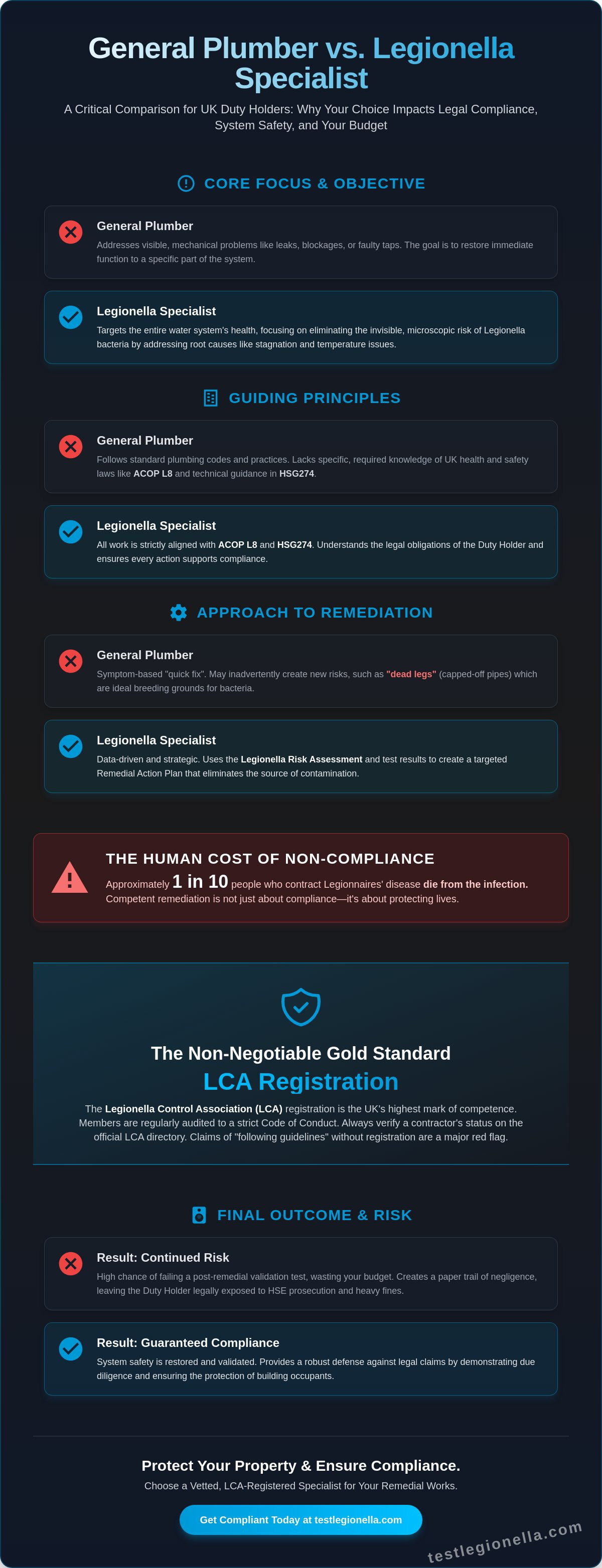
Every remedial task must align strictly with the acop l8 code of practice. This document provides the legal framework for control, while HSG274 Part 2 serves as the technical roadmap for hot and cold water systems. A qualified specialist should cite these documents fluently in their proposal. If a contractor cannot explain how their work meets HSG274 standards, they lack the technical grounding to ensure your property remains compliant. Following these guidelines ensures that your system doesn't just look better, it functions safely.
The Risk of Non-Compliance
It's vital to distinguish between a 'recommendation' and a 'mandatory' remedial action within your report. Mandatory actions fix immediate breaches of the law, while recommendations improve long-term system resilience. Inadequate remediation often leads to the continued growth of legionella bacteria, meaning you might pay for repairs that fail to pass a subsequent test. True competence means the specialist possesses the training and experience to guarantee that the work performed actually mitigates the biological risk present in your specific system.
Essential Credentials: What Every Specialist Must Have
Vetting a specialist requires more than a cursory glance at a website. You need a partner whose expertise matches the complexity of your water system. This choice directly influences how legionella testing informs remedial action plans, as the data dictates the level of expertise required for the job. A residential landlord managing a few flats needs a different skill set than a facility manager overseeing industrial cooling towers or complex healthcare environments. Ensure your chosen specialist has proven experience in your specific sector before signing any contracts.
Why LCA Registration Matters
The Legionella Control Association (LCA) registration is the industry gold standard in the UK. It isn't just a badge; it's a commitment to a strict Code of Conduct that prioritizes public safety. The LCA regularly audits its members to ensure their service delivery meets rigorous professional standards. Don't take a contractor's word for their status. Visit the official LCA directory to verify their membership personally. You should be wary of companies that claim to 'follow' LCA guidelines without being registered members, as they lack the external oversight necessary to guarantee compliance.
Technical Certifications and Training
Technical proficiency is non-negotiable. Look for technicians who hold certifications from recognized bodies like City & Guilds or the British Occupational Hygiene Society (BOHS). These qualifications prove that the person on your site understands the nuances of water hygiene, which is fundamentally different from general plumbing. Since safety standards are updated frequently, ask for evidence of recent refresher training. This ensures your team is current with 2026 standards and understands OSHA guidelines on Legionella control alongside UK-specific legislation. A clear understanding of how legionella testing informs remedial action plans ensures that the credentials you verify today prevent a failed inspection tomorrow.
Liability protection is your final safety net. Every specialist must carry robust Professional Indemnity and Public Liability insurance to protect your property and your business during the works. Once the remediation is finished, insist on a 'Certificate of Conformity'. This document serves as your official record that the system has been restored to a safe state according to current regulations. If you're currently holding a risk assessment and aren't sure of the next step, booking a professional Legionella compliance test can provide the clarity you need to move forward with confidence.
Specialist vs. General Plumber: Understanding the Difference
Hiring a standard plumber to fix a legionella issue is like asking a car mechanic to perform heart surgery. Both understand the machinery, but only one understands the biology. General plumbers prioritize flow and the absence of leaks. A specialist prioritizes hygiene and the elimination of stagnation. This distinction is vital because how legionella testing informs remedial action plans depends on identifying why bacteria grew, not just where the water is moving. A specialist looks at your system through the lens of risk management, ensuring every modification prevents future colonization.
Material choice is another area where generalists often stumble. Specialists exclusively use WRAS (Water Regulations Approval Scheme) approved materials. These components are tested to ensure they don't leach nutrients into the water that could support biofilm growth. Beyond materials, the specialist focuses on temperature profiles. It's not enough for water to feel hot to the touch. It must reach 60°C at the calorifier and at least 50°C at the outlets within one minute to meet UK compliance standards. If your contractor doesn't own a calibrated thermometer, they aren't equipped for the job.
The Complexity of Dead Leg Removal
A dead leg is a length of redundant pipework where water sits and stagnates. An untrained plumber might simply cap a pipe off, but if they leave a stub longer than twice the pipe diameter, they've created a new bacterial breeding ground. Specialists use a risk-based approach to cut pipes as close to the main "tee" as possible. This ensures zero stagnation and protects the integrity of the whole system. They understand that minimal stagnation is the foundation of a safe design, and they'll prioritize removing these hazards over simple convenience.
Water Tank Compliance and Hygiene
Swapping a water tank seems straightforward, but a standard installation often misses critical safety features required by ACOP L8. A compliant legionella tank requires screened overflows to keep insects out, tight-fitting lids to prevent debris entry, and robust thermal insulation. A specialist won't just turn the water back on after the work is done. They'll perform a full system disinfection to ensure any bacteria introduced during the intrusive work are eradicated. This proactive step ensures your property is safe from the moment the system is recommissioned.
A 5-Point Vetting Checklist for Your Remedial Action Partner
Selecting a partner to carry out remedial works shouldn't be a guessing game. A structured vetting process protects your budget and ensures your building remains compliant with UK law. Understanding how legionella testing informs remedial action plans is your starting point; the laboratory data dictates exactly which parts of the system require intervention. Use this five-point checklist to ensure your chosen specialist is up to the task:
- Review the Proposal: Does the document directly reference the specific findings and high-risk areas identified in your latest Risk Assessment?
- Check Methodology: Always request a written Method Statement and Risk Assessment (RAMS) specifically tailored to the works being performed.
- Verify Materials: Insist on a written guarantee that all fittings, valves, and components are WRAS approved to prevent future contamination.
- Audit the Paperwork: Confirm that the specialist will provide a comprehensive completion report and update your on-site logbooks immediately.
- Post-Work Testing: Ensure the plan includes or strongly recommends independent water sampling to validate that the remediation was successful.
Before hiring any contractor, ensure you have an accurate baseline of your system's current health by booking your Legionella compliance test today. This data is the only way to hold a remedial partner accountable for the results they deliver.
Interpreting the Specialist Quote
Beware of vague "lump sum" quotes that lack detail. A professional proposal should provide an itemised breakdown of specific tasks, such as dead leg removal or tank cleaning. Check if the quote includes the essential cost of water system disinfection, often referred to as chlorination. Without this, the work is incomplete. You should also ask if the specialist provides "before and after" photographic evidence. Seeing the physical removal of a scale-heavy pipe or a corroded tank provides the reassurance that your money was well spent.
The Importance of Method Statements
A professional specialist will clearly explain how they intend to manage risks during the work itself. This includes specific measures to prevent the spread of aerosols, which is the primary way legionella bacteria are inhaled. Verify their plan for "flushing" the system once the physical modifications are complete to remove any debris or stagnant water. Their strategy should also account for minimal disruption to your building's occupants. A well-organized partner understands that safety and operational efficiency must go hand in hand, ensuring a smooth transition from a state of risk to a state of total compliance.
Post-Remedial Validation: Ensuring Your Investment Worked
Remedial work is officially incomplete until you hold a clear laboratory result in your hand. While physical repairs solve structural issues, only microbiological analysis proves that the biological threat has been neutralized. This validation step is the final piece of the puzzle in how legionella testing informs remedial action plans. It moves your property from a state of identified risk to a state of verified safety. Without this evidence, you have no way to prove to the HSE or local authorities that your system is actually under control.
You must prioritize independent testing. It's a significant conflict of interest to allow the same contractor who performed the repairs to carry out the post-remedial sampling. To ensure total transparency and legal protection, hire a third-party specialist for your validation samples. This ensures the results are unbiased and provides an audit trail that stands up to regulatory scrutiny. Once you have these results, update your Legionella Log Book immediately. This document must reflect the completed works, the date of disinfection, and the new test data to maintain a continuous record of compliance.
Professional Water Sampling and Analysis
Always ensure your samples are analyzed by a UKAS-accredited laboratory. This accreditation is your guarantee that the testing follows national standards for accuracy and reliability. Timing is also critical; you shouldn't take samples immediately after a chemical disinfection, as residual biocides can cause false negatives. Wait between two and seven days after the system has been flushed and returned to normal operating temperatures. A clear test result is your ultimate 'get out of jail free' card for compliance.
Maintaining Your Compliance Status
Think of remedial work as a system reset rather than a permanent fix. If the remediation involved significant changes, such as installing a new water heater or replacing a cold water storage tank, you need a revised risk assessment to reflect the new system architecture. This ensures that how legionella testing informs remedial action plans remains a dynamic process that evolves with your building. Integrate these new assets into your monthly temperature monitoring regime right away. Continuous vigilance is the only way to prevent the return of bacterial growth and protect your investment.
Ensure your remedial works were successful with a professional Legionella test from Test Legionella.
Secure Your Compliance Future Today
Achieving total water safety in 2026 requires more than simple repairs; it demands a data-driven strategy. By understanding how legionella testing informs remedial action plans, you'll move away from reactive fixes and toward a proactive, compliant management system. Remember that verifying credentials like LCA registration and distinguishing between general plumbing and specialist hygiene are the keys to protecting your building from legal risks. Your investment in remediation isn't truly validated until an independent laboratory confirms the system is clear and safe for use.
Take the first step toward stress-free management and long-term security. Book your professional Legionella compliance test today to receive UKAS-accredited laboratory analysis and fast, professional reporting tailored for landlords and businesses. Our expert guidance ensures you maintain national compliance standards while prioritizing the safety of your occupants. Secure your property today and enjoy the tranquility that comes with expert-led water safety.
Frequently Asked Questions
Can my regular maintenance plumber carry out Legionella remedial works?
Your regular plumber should only perform these works if they possess specific qualifications in water hygiene and legionella control. While standard plumbers are excellent at fixing leaks and ensuring flow, they often lack the training to identify biological risks like dead legs or aerosol generation. Hiring a specialist ensures that the work complies with ACOP L8 standards, protecting you from future legal liability and ensuring the system is biologically safe.
How long does Legionella remedial work typically take to complete?
The duration of remedial work depends entirely on the complexity of the findings in your risk assessment. Simple tasks, such as removing a single dead leg or insulating a small tank, can often be completed within a few hours. More extensive projects involving full system disinfections or calorifier replacements may take several days. A competent specialist will provide a clear timeline in their proposal to minimize disruption to your daily operations.
What is the most common remedial action required after a risk assessment?
Removing dead legs and adjusting water temperatures are the most frequent corrective steps. These issues often arise when buildings are modified without updating the original pipework, leading to stagnant water. Understanding how legionella testing informs remedial action plans helps prioritize these tasks, as laboratory results can pinpoint which sections of the system are actively harboring bacteria. Fixing these common faults is the fastest way to restore your property's safety status.
Do I need to vacate the building while Legionella remedial work is being done?
You rarely need to vacate the building, though you should expect temporary water isolation in specific areas. Specialists plan their work to minimize impact on occupants, often working on one section of the system at a time. If a full system chlorination is required, you'll be advised not to use the water for a few hours. Clear communication and proper signage from your contractor will ensure everyone stays informed and safe throughout the process.
Is it a legal requirement to hire an LCA-registered specialist?
It isn't a strict legal requirement to use an LCA-registered company, but the HSE strongly recommends it as evidence of competence. As a Duty Holder, you're legally responsible for ensuring that anyone working on your water system is qualified. Choosing an LCA-registered specialist provides a robust defense in court by proving you followed industry best practices. It's the most reliable way to transform complex regulatory burdens into documented security.
What happens if I ignore the remedial actions suggested in my risk assessment?
Ignoring recommended remedial actions leaves you vulnerable to HSE prosecution and heavy financial penalties. If an outbreak occurs and you haven't acted on your risk assessment, you could face charges of corporate manslaughter or negligence. Beyond the legal risks, you're allowing a known health hazard to persist in your building. Taking swift action is the only path to maintaining a safe environment and achieving stress-free management of your property.
How much does a typical Legionella remedial action plan cost?
Costs vary significantly based on the size of your property and the number of faults identified. For smaller commercial buildings, a risk assessment might cost between £200 and £500, but the subsequent remedial work is quoted separately. Large-scale remediation for complex buildings can range from £20,000 to over £80,000 depending on the number of hot water loops and the chosen method. Always request an itemised quote to ensure you aren't paying for unnecessary repairs.
Should I re-test my water immediately after the remedial work is finished?
You should wait between two and seven days before taking validation samples. Testing immediately after a disinfection can lead to false negatives because residual chemicals might still be present in the pipes. This waiting period ensures that how legionella testing informs remedial action plans provides an accurate picture of the system's long-term safety. A successful re-test after this gap confirms that your remedial investment has effectively restored compliance.